The Netherlands asks ChatGPT
Millions of Dutch people now ask ChatGPT first, before they search. In March 2026, Newcom counted 7.2 million Dutch people aged 18 to 65 using AI in daily life, up from about 5 million a year earlier. ChatGPT is by far the most-used tool (Emerce). In September 2026 it handled 82.94% of AI chatbot visits in the Netherlands (Statcounter).
Now it is November, and every Dutch household gets the same question: should I switch health insurance? Insurers publish their 2027 premiums by 12 November, and you have until 31 December to switch. That makes it one of the biggest yearly money decisions people bring to a chatbot.
The problem: ChatGPT does not have this year’s data.
Why ChatGPT gets it wrong
People ask for the latest numbers, and the model answers from old ones. A language model knows what was in its training data, and that stops at a cutoff months before you ask. The 2027 premiums did not exist when any current model was trained.
This is not only about premiums. The market itself changes every year:
- ZEKUR stops on 1 January 2027 and its customers move to Univé (Univé).
- Anderzorg merges into Menzis on 1 January 2027 (Anderzorg).
- Contracts between insurers and hospitals, physiotherapists or mental health providers change every year. With a budget policy, that contract decides whether you pay the bill yourself.
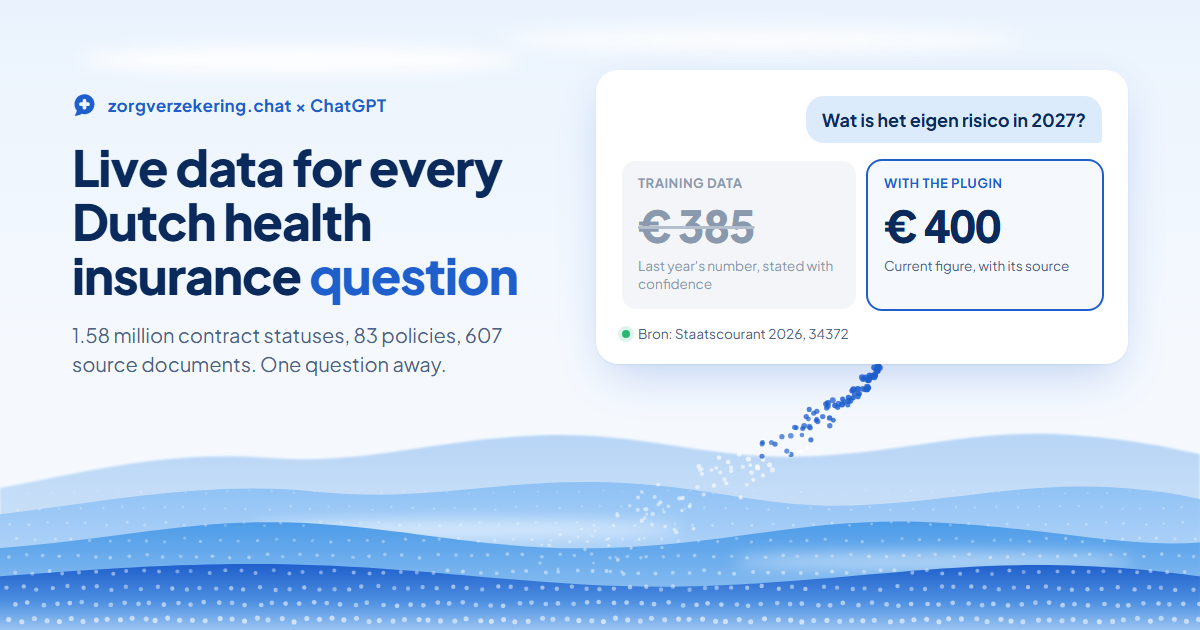
Even the basics move. The mandatory eigen risico goes from € 385 in 2026 to € 400 in 2027 (Staatscourant). A model trained on last year’s data will tell you € 385, with full confidence.
Web search does not fully fix this. ChatGPT then cites whatever pages rank, and some comparison pages for 2027 still list Anderzorg as a separate insurer. When the model has no number, it may make one up.
So I built a plugin
zorgverzekering.chat is now a plugin for ChatGPT. It gives ChatGPT live access to every Dutch health insurance policy, so it stops guessing. Ask about premiums, coverage or contracts, and ChatGPT calls my server for the current numbers.
Under the hood it is a remote MCP server with 12 read-only tools and six skills. The skills tell ChatGPT how to run a comparison: ask the right intake questions, call the tools, show a table of yearly costs, and cite the source.
| You ask | What the plugin does |
|---|---|
| What will my household pay in 2027? | Calculates yearly costs per policy, including eigen risico and costs not covered |
| Which supplementary insurance covers braces and physio? | Searches all supplementary and dental packages by coverage |
| Does my policy have a contract with my hospital or physio? | Checks the contract status per care provider and policy, with date and origin |
| What changes in my policy next year? | Compares a policy across years and quotes the policy terms |
| What is the eigen risico, and when must I switch? | Returns the statutory amounts and deadlines |
Some rules I built in from day one:
- Every number has a source. Each answer cites the insurer’s document. Amounts from the model’s memory are not allowed.
- Information, not advice. The plugin compares and calculates. You decide and sign up with the insurer yourself.
- Privacy by design. The tools are stateless and hosted in the EU. Nothing about your health is stored. For expected care use, the tools accept only coverage codes and counts, never diagnoses or medication.
- Dutch and English. Expats get the Dutch terms explained.
The same server also works in Claude, Gemini CLI, Cursor and VS Code.
Millions of data points, one question away
The plugin sits on 1.58 million contract statuses: for each of 25,909 care providers, whether each of 83 basic policies has a contract with them. Each status has nine fields, so that is close to 15 million data points.
| Dataset | Size |
|---|---|
| Contract statuses (care provider × policy × type of care) | 1,584,725 |
| Care providers in the register | 26,522, at 35,710 locations |
| Coverage rules in supplementary and dental packages | 5,238 |
| Source documents (premium lists, policy terms, coverage guides) | 607 |
| Group schemes (municipalities, associations) | 438 |
| Supplementary and dental packages | 390 |
| Basic policies | 83, from 38 insurer labels |
The contract data covers ten types of care. The biggest are physiotherapy (575,796 statuses), GPs (367,343) and mental health care (325,355). Pharmacies, hospitals, clinics, district nursing, rehabilitation, exercise therapy and lab diagnostics are in there too.
I collect this data from the insurers’ own publications and contract search tools. Every status carries the date it was retrieved and an expiry date, so the plugin knows when it needs a fresh lookup. The 2027 premiums go in as soon as insurers publish them, by 12 November.
All of it is one question away. You do not need to open 38 websites and 607 PDFs. You ask ChatGPT, and it asks my server.
How to use it
In ChatGPT, open the plugin directory, search for Zorgverzekering.chat and add it. Then just ask your question in Dutch or English.
Prefer to connect it yourself, or using another client? The MCP server needs no login:
https://mcp.zorgverzekering.chat/mcpIn ChatGPT, turn on Developer mode under Settings > Apps & Connectors > Advanced, then create a connector with that URL. In Claude, Cursor, VS Code or Gemini CLI, add it as a remote MCP server.
Some questions to start with:
- “Wat is de goedkoopste basisverzekering voor volgend jaar?”
- “Welke aanvullende verzekering vergoedt een beugel voor mijn kind en 12 keer fysiotherapie?”
- “Is my hospital contracted by the cheapest Dutch health insurance policy?”
- “We are a family of four in Utrecht. What is the cheapest combination for 2027, including braces and physio?”
- “Wat verandert er aan mijn polis tussen 2026 en 2027? Citeer de voorwaarden.”
Why I think this matters beyond insurance
For twenty years, getting your information to people meant ranking a page. In AI assistants, the better position is being the source the assistant calls. A page can be outdated, paraphrased wrongly or ignored. A tool returns the current number with its source, every time someone asks.
Health insurance is a good test case: the data changes every year, the stakes are real, and millions of people ask the same questions in the same six weeks. If it works here, it works for any market where people need data from this week, not from the last training run.
Try it this switching season, and tell me what it gets wrong. You can reach me at help@zorgverzekering.chat.
Sources
- Emerce: 7,2 miljoen Nederlanders gebruiken AI (Newcom AI Monitor, March 2026)
- Statcounter: AI chatbot market share in the Netherlands (September 2026)
- Staatscourant 2026, 34372 (eigen risico 2027)
- Univé: ZEKUR veelgestelde vragen
- Anderzorg wordt Menzis
- Data counts: zorgverzekering.chat database, retrieved 28–29 October 2026